Recent Blog
Recent Blog
Showing posts with label Social Media Marketing. Show all posts

10 December 2018

Social Media: is it for your Business?

Author :


Social Media is possibly the biggest game changer when it comes to growing businesses within the era of the Millennial. According to socialmedianews.com.au over 15,000,000 Monthly Active Australian Users on Facebook and 9,000,000 Monthly Active users on Instagram, there are more people than ever accessing the ‘social’ side of the internet. Keep in mind this is only in Australia! Social Media is one of if not the most influential platforms to young people and now also older generations too. With over 6 in 10 Australians using Facebook and 1 in 2 of them using it daily. Critically companies must adapt to this as they grow their business within the digital age. Some businesses do this extremely well with collaborations with international social media influencers other brands remain lacklustre, and it ultimately causes their demise. Digital is evolving, using the power of social media to create business awareness is the way forward for 2019.

Still not sold on the idea of Social Media for your company? In 2016 the Western Australian Tourism released a series of Magical Stories that featured in all of the beautiful locations in Western Australia these clips were released over a series of years and are still being used today with the justanotherday.westernaustralia.com website. Now, don’t get me wrong in the beginning this campaign had a few hiccups with some people using the campaign hashtag to spread words of negativity. But, over two years later since the campaign first began Instagram has seen more than 600,000 posts of quality images and videos of people enjoying
Western Australia.


Social Media will never completely be something that is 100% a positive thing, and we have to allow people to share their opinions but often after a little bit of drama dies down the outcome can be significant. This #Justanotherdayinwa campaign is an excellent example because although there was slight controversy in the beginning two years on there is still a variety of people that continue to post content on using this hashtag. The content is also high-quality using Drones, DSLR cameras and are all epic shots featuring Western Australian landscapes. All in all, this is a successful government campaign that has drawn A LOT of attention to Western Australia.

Social Media can be a great tool when used correctly, but often people who use it don’t understand who they are marketing towards. Target Market is one of, if not the most important parts of your social media strategy. Understanding who your target market is to be able to grow your following to in turn increase your business is a huge part of being successful on Social Media. You could have 10,000 followers on social media, but if none of them is your ideal client, then you’ve got a problem because you probably aren’t making any sales for your business When people with only 1,000 followers might be twice as successful as you. One Australian Business that has grown a considerable amount in the last 12 months is Tribe Skin Care which now makes over $90,000 of sales a month with their business
strategy.

Photo: Instagram.com/tribeskincare


That majorly has focused on social media marketing using paid influencer promotion. All from her home office in her house mind you! Tribe Skin Care is a perfect example of understanding who their target market is and being able to develop relationships with influencers who also have followings of these same target market to build authentic business practices.

Photo: Instagram.com/tribeskincare

Social Media has been proven to grow businesses exceptionally quickly as well as developing plans to build businesses. With Social Media such a prevalent part of society it is only right that companies start to adapt to use social media to grow and ultimately see tremendous results with growth and engagement. 

Written by: Lavinia Wehr 

That majorly has focused on social media marketing using paid influencer promotion. All from her home office in her house mind you! Tribe Skin Care is a perfect example of understanding who their target market is and being able to develop relationships with influencers who also have followings of these same target market to build authentic business practices.


14 November 2018

Four social media metrics that matter more than ‘likes’

Author :


I have banned the words ‘reach’, ‘likes’ and ‘social actions’ at the University of Sydney.

When I’m asked to report on how many ‘likes’ a post or campaign got, I break out into a sweat and worry I’m turning into a lipstick wearing, floral dress loving version of The Hulk.

It’s not because I don’t want people to like our content, like some sort of social media Grinch. It’s because the way that people interact with content social media has changed ( link:  https://www.entrepreneur.com/article/308393 ).  Metrics like reach and likes are impulses split second reactions as content moves through the feed. They don’t tell us anything about the wants and needs of our audience.

Here are four metrics to use in your next content report that mean much, much more than likes.

Landing page views and CTRs

Anyone can click ‘like’ on a pretty picture or a funny meme, but it takes an invested audience to actually click through to your webpage( link: https://www.facebook.com/business/help/361750134220832 ) (an environment not owned or controlled by Facebook. )

Furthermore, what percentage of the audience who saw your post clicked through? This is called the Click Through Rate (CTR) ( link: https://www.facebook.com/business/help/928745330472862 ) . A low CTR means people are seeing your post and not acting on it because it doesn’t resonate (or you’re perhaps targeting the wrong audience).  A high CTR means it’s hitting the mark.

Both of these metrics can be charted in the Facebook insights tab. Rather than comparing your page’s metrics to industry benchmarks or competitors, start by competing with yourself. Work out what your existing average is and start experimenting with content and audiences to improve it.

CPC and CPV

“How many likes will I get for $100 on Facebook?” This is another question that feeds the social media Hulk in me.

 Look beyond the likes and prove return on investment for your social media activities by analysis how much you’re paying in terms of cost per click (CPC) and cost per view (CPV) ( link: https://adespresso.com/blog/facebook-ads-cost/ ).

When it comes to Facebook ads, the platform works like an auction rather than a store.  You identify who your audience is and can manually adjust how much you’re willing to pay compared to competitors for a specific action (click, view etc) from that audience.  This, and the relevance of your content (as well as many other factors) determine how much you’ll pay per action.

To see return on investment; take a look at these stats in your page’s Ad or Business Manager tool. Take note of the CPC for content and the CPV for video and aim to work out what wording, creative and audience attributes get the lowest cost per engagement for your brand.

Tagging in comments

The way consumers ( particularly millennials ) are using social media has changed ( link: https://medium.com/@dooleymr/a-new-era-in-social-media-why-millennials-arent-sharing-anymore-15ffe99b9165 ). Have you noticed people don’t post status updates or even share posts anymore?

In the wake of Cambridge Analytica ( link: https://www.theguardian.com/news/2018/mar/18/what-is-cambridge-analytica-firm-at-centre-of-facebook-data-breach ) and with the rising importance of personal branding and maintaining a squeaky clean digital footprint, sharing content with all of your network is waning.  Facebook users are now far more likely to tag relevant friends in the comments section of content that resonates than share it on their ‘walls’.

Instead of reporting on how many likes you latest post or video got, keep a record of how many people tagged others in the comments to gauge its impact and relevance.

Average watch time

A view on Facebook is three seconds. How much information can you really get from something in that time? Your video may have got 50,000 views, but how many of the people who watched it got past the title slide?  ( link: https://marketingland.com/6-metrics-measure-success-facebook-videos-224452)

Instead of reporting on video likes, or even views, look into your Facebook analytics to determine how many of the total views watched for 10 seconds or more, and what the average watch time is (prepare to be disappointed, Facebook studies have revealed it’s about 10 seconds across the board).

Again, chart what your existing average watch time is, and work at creating video content that gets the call to action across in the first few seconds, and then aims at engaging the audience for more than ten. Make your videos as short and snappy as possible and watch the average view times soar.

What metrics do you report on for social media? How do you track audience engagement and content resonance? I’d love to hear from you on LinkedIn @ HERE

Still interested? Stay tuned for information on upcoming conferences and summits by following us on Facebook @ Akolade Aust 

Written by: Jenna Bradwell, Social Media Specialist, Marketing and Communications Division at The University of Sydney                                                                                               

Jenna is a social media specialist with a passion for crowd sourced content, social media activations and effective paid social strategy. Outside of work she is a wine lover, culture-enthusiast and passionate hater of Instagram's 'Valencia' filter.


12 November 2018

Tips to get the most value out of your social media

Author :


Social media is something that will continuously change and develop. With so many new social platforms out there it really becomes difficult to understand where the hype and trend is happening. But for organisations, the question still remains: what is the best way to gain maximum value out of your social media?

Let’s dive into some easy and simply tips that can help you get the most value out of your social media:

            1. Embrace influencer marketing –

sThe power of influencer marketing is increasing than ever before. In 2017 influencer marketing was the fastest-growing online acquisition method of the year! This trend is spreading like wildfire and as a result organisations are spending big bucks on making this part of their social media strategy. By giving people the opportunity to share their passion on certain topics can immensely shape and influence audience opinions. For organisations it’s really about making the right choice with their influencer’ and knowing how much value they can add to your long term goals and strategies. 

2. Establish a solid social media strategy –

It’s easier said than done! Your social media strategy really needs to align with your organisational strategy. What is your organisation about? What services do they provide? How can the benefit everyone? These things should be heavily considered when developing your own social media strategy. Knowing your social platforms and understanding where the hype is occurring can really help the community engage with your business. The content needs to be timely and being able to implement and capitalise on your data can really assist in understanding where the buzz is happening and why. Benchmarking yourselves can push you to stretch your limits and delve into content that you probably wouldn’t touch before.

3. Leverage data  -

Numbers, metrics, data, statistics – these all contribute to provide actionable insights concerning your social media strategy. Some of the raw data that everyone uses are: likes, shares, mentions, comments, hashtag usage, etc. Although this is only bare minimum of what social media strategists look at, but from this we can begin to understand that things like this can help us monitor online social media behaviour.  At the end of the day, organisations use data and analytics to measure their return on investment. If you aren’t getting dollar value out of your social media, then something is amiss. It may be time to reconsider your strategy.
  
4. Engage your audience  -

Social media isn’t truly active without your audience. Trying to engage the right target audience can be tough. But if you keep your content, short, simple and sweet the target market do respond. The success of your engagement really lies in the way you shape your content. Timely content is key – being ahead of the game and aware of trending news is what keeps your audience engage and your social media alive. Strategically using your hashtags is also another key tip – these hashtags makes it’s easier for people to find you and helps you hop onto trends in your market. Encouraging your audience to share posts can help build audience numbers and ultimately creates an active social network.

Still interested? Stay tuned for information on upcoming conferences and summits by following us on Facebook @ Akolade Aust 

Written by: Vishi Peters 
Vishi is a Conference Producer of Akolade’s Government and Digital portfolio. She has a strong interest in current affairs and enjoys giving an educated opinion about emerging trends. She is passionate about photography, enjoys playing cricket, cooking different cuisines and expanding her food knowledge.   


Follow me on LinkedIn for information regarding future Akolade events as well as future blog posts @ Vishi Peters

30 July 2018

Why it’s dangerous not to own your own channels

Author :
Brands have long used social platforms to connect with and build out their audiences. Collecting fans like baseball cards, they would pour significant ad spend into Facebook’s brand-favouring algorithms, relying on third-party data to deliver ads and reach potential new users. Obviously, this has changed significantly in the last six months as Facebook removed third-party data offerings and updated the news feed feature to prioritise user content vs. branded content.

Of course, this isn’t the first time that a social company has shaken things up. When Twitter shut down Vine in early 2017, it was devastating for brands and influencers that relied heavily on the video app to reach their thousands (and sometimes millions) of viewers. By delivering content on a channel they neither owned nor operated, they had given up the right to own their audiences as well, and had to dramatically shift to new channels to stay afloat.

So what does this mean?

It means that brands taking a long term perspective by building directly-owned audiences will ultimately be better off than those renting theirs from social platforms. Smart companies need to be asking themselves: how do we build audiences that are safe from external forces?

A brand should own its audience and means of content delivery - and now more than ever, the tools to do so are readily available. The elements needed for owned and operated channels are simple:

Something of interest that will drive people to your site.

This can truly be anything, as long as it’s of value to your audience. Thought-provoking and relevant content is a big one, like new blog posts, high quality video assets, product stories, case studies, etc. Having a major sale is another surefire way to draw people in. By driving consumers to your site, rather than engaging with them on social, you are increasing the chance that they might stay, look around, and become a repeat customer.

A quality CRM and marketing system.

The marketing value that comes from social platforms is their ability to gather, store and distribute information about individuals. Understanding consumer behavior is critical, which is why brands are drawn to using those channels. But with a proper CRM, you have the ability to create your own system of collecting data around your user behavior. Even on a small scale, mimicking how sites like Facebook track user data will add value to your company and get you set up to best market your products.

A sense of community.

It’s called social media for a reason - people are simply drawn to other people. Creating a sense of community on your own channel, where like-minded consumers can interact with each other as well as with your brand, is definitely going to set you apart.
To put it simply, companies don’t have to rely solely on Facebook and YouTube to communicate with their followers, and every day we’re seeing more and more moving in the direction of owning and operating their own channels. By driving people to their own websites and delivering content to them directly, they are ensuring their own future success and eliminating external risks altogether. So the next time there is a shake-up in the social arena - which is a ‘when’, not an ‘if’ - make sure you are not on the short end of that stick.

Still interested? Stay tuned for information on upcoming conferences and summits by following us on Facebook @ Akolade Aust 

Written by: Fritz Brumder


CEO & Co-Founder, Brandlive 


23 March 2018

Why content is king

Author :


You've probably heard the saying "content is king" but exactly how royal it is, is usually overlooked. 
Let's put this in context. 

You’re lounging around one night, engrossed in the latest episode of your favourite TV series (think MKR or MAFS), and of course, the show breaks for the ads. Usually you'd whip out your phone and distract yourself with what's happening on Facebook (marketing people call this "double screening") but some ad catches your eye. Not because it's funny, but because it's a little weird. 

The screen goes completely black and all you hear is a 40 something year old voice-over guy putting on his best game-show host voice blasting a pre-written script trying to convince you to buy his latest product. 

Usually this ad would best for the radio… but weirdly, it's on TV.

Okay so this hasn't really happened, but I'm trying to demonstrate a point. 

You wouldn't put a radio ad on TV, it just wouldn't be right. So the same goes for your social media content. If something wasn't made for social media, why should it go on social media? 

I see this all the time - a video that was originally cut for a website, a brochure that was meant for a mailbox, a screenshot of a PDF.

The newsfeed is so competitive these days that this type of repurposed content will no longer achieve cut through. We all have hard KPI's that need to be met - usually it involves how many people the content reached and if you're working in a government like me, usually the powers that be would like to know an indication of sentiment. 

How can you track these metrics if you have no one engaging in your content!

Let me show you an example. Recently, we storyboarded and shot a bespoke three part video series to celebrate one of our assets, the 85th birthday of the Grafton Bridge. 

You can see the videos here: 


During a two day trip to Grafton, we developed this series heroing everyday "Graftonians". Nothing was scripted, my only brief to our talent *ahem* everyday people was to pretend we were at a BBQ and we were just having a conversation. 

Organically, we achieved 40,000 views and reached over 88,000 people. For a small regional town with a population of 18,668 people, this means that we reached new audiences and the content resonated with audiences wider than just the locals. We also achieved almost 100 per cent positive sentiment.  

To give you some perspective, before creating this bespoke content, we had only ever achieved views in the 10,000 mark and that's if we were lucky. By creating the piece specifically for social media, our content not only performed well, but allowed us to expand our audience. 

We did this by changing a few things: 

·         Language - we spoke in a casual tone, even though some of our message was quite technical
·         We featured unstaged, behind the scenes content
·         We kept our content short and sharp by making the audience feel like they were there
·         We knew who our main audience was and for each video, and we tailored our content towards that (for example the audiences for our third video skewed male because of some of the technical terms).

By making these small changes, we saw such an improvement in the performance of the content, and we have kept it up! Visit our page to see more. Facebook.com/nswroads

Written by: Debbie Hatumale-Uy 


Debbie Hatumale-Uy is the Social Media Manager at Roads and Maritime Services, a division of NSW Government. She has previously worked as the Social Media Manager at McCann Worldwide Group, as the Digital Communications Specialist at Canon Australia, and the Online Community Manager at McDonald's Australia. She is passionate about leading organisations into the wide world of social media, and spreading the importance of content in that journey. 

07 February 2018

How to Be One of Our Best Speakers – Winning Over the Hearts (and Minds) of Your Audience

Author :

Having watched countless presentations ranging from piling and deep foundations to Artificial Intelligence, read volumes of feedback across almost every industry event, and spent countless hours networking and researching, it’s pretty clear what makes the most compelling presentation.

As a rough guestimate, I would have seen around 400 presenters over 22 events.

And regardless of audience feedback, I’m a person with only surface knowledge of the topics we cover, so to be engaged by a speaker from an industry which is pretty foreign to me is a big ask.

***Full disclaimer – the opening remarks are enough pressure to spin me into a shy, nervous panic and make me crumble, and that is only a matter of minutes on stage. So hats off to the rest of you who bear 30 minutes of it, before being put on the spot with impromptu and often demandingly specific questions for another 10.

The thing is, you either have it or you don’t - humour on stage that is. And most of it comes from confidence. However, humour is probably the last thing on your mind when you are standing vulnerably in front of leading executives for 40 minutes convincing them you are worth listening to.

It’s a great icebreaker, but not a necessity. In my humble opinion, listeners want 3 things:

Engagement:

You don’t have to be a stand-up comedian to win over the audience’s hearts with humour.

Whether you were the ’class clown’ or not, if you stand up there with the intention of enjoying yourself and act as though you are having a one-on-one light-hearted conversation with the audience (interlaced with serious, meaningful insights), your authenticity and quirks are bound to shine through and ensure you’re seen in an endearing light. Not only this, your audience will connect with you and remember a lot more of what you say. It’s hard to relax on stage, but if you do, it’s bound to pay off.

I’m hooked as soon as I see someone is passionate about what they do. I want what they have. It’s human nature to want to be excited about something – and it makes you want to hear more to figure out why they’re so enthusiastic about this topic.

It’s incredibly contagious, everyone has the inherent ability, and no one can resist its charm.
Passion aside, do a show of hands, prompt them with questions to discuss with the person next to them, make them feel included.
  
Insight:

It’s kind of an obvious one, but people want golden nuggets. The ‘Aha!’ moments that just click and help all the pieces of the puzzle connect. They want to see themselves in your story and link parts of what you have done, or the mistakes you have made, to their experience to help navigate the next part of their journey. Future thinking, opinion, imagination, anything thought-provoking is absolutely key in being remembered as insightful.

Don’t hold back with sharing your vision, people crave a bit of dreaming big.
But then you also need to balance this with proof.

As great as vision is in winning over your audience, there also need to be cold, hard facts, practicality and measurable past wins to give you credibility.

The old adage ‘the proof is in the pudding’, meaning you can only judge the quality of something after you have tried, used, or experienced it, is very relevant here.

Which leads me to the final factor:

Honesty:

All we want is for you to drop the act that everything has worked out successfully and instead, air the dirty laundry.

We are all human. It’s actually a badge of honour to have failed, and failed fast, these days. To have tried something new and had the ability to look at why it failed, then have the guts to share that with your peers is bigger picture action and collaboration.

It’s refreshing in a world of facades to be brave enough to be transparent and speak openly. As much as you think it will bruise your professional image, these days, that couldn’t be farther from the truth.

Written by: Gracie Fea

Originally from NZ, Gracie worked as a Broadcast Journalist for a few years before moving to London, and then to Sydney, where she fatefully came across conference production and quickly realised it was her dream role. Getting to speak with such passionate and successful people and create an agenda so that people can see themselves in other’s experiences, really spins her wheels.

She has a hunger to hear everyone’s unique story and really thrives from creating a platform for them to share these and help move their industry forward through collaboration.


23 January 2018

Keeping students safe on social media platforms

Author :
We’re dealing with a generation of digital-engagers. ‘Screen-agers’ if you will. Right or wrong, a majority of Gen Z’s social interactions take place on social media and in the online universe.

As of 2017, approximately 99% of 18-29 year olds and 96% of undergraduate students in Australia actively use social media on a daily basis.

Research conducted by the ACMA (Australian Communications and Media Authority) has shown that the number of Young Australians who rate the internet as ‘very important’ has doubled since 2009.

For students in higher education - whether it’s Universities, TAFEs, VETs, RTOs or other – the pros and perks of social media engagement are compelling. Offering opportunities for real-time engagement with peers and professors, access to information, sharing ideas, finding social events or simply expanding your circle of friends, the boom of social media has changed the face of student interaction.

Not only this, but from a University’s business perspective, it seems the most powerful tool for current and prospective student engagement is in the online universe. Using social media effectively can expand market scope, increase student recruitment and drive engagement. 

However, it’s a risky space.

There is little denying the social media makes it easier for students to bully or abuse their peers — coupling the sense of anonymity with an seeming lack of consequence for negative comments and bullying, the online universe can be a hostile place for young people. Particularly when personal information is not protected and/or students aren’t aware of how to keep themselves safe on social media, the dangers can become much more real than the benefits.

It’s imperative that Universities understand the best strategies for maintaining a safe social networking space, and encourage students to learn more about how to stay safe on social media. When used safely and effectively, online social platforms can act as a strong catalyst for engagement and positive student experience throughout their higher education journey.

What policies and procedures does your organisation have in place for the use of social media?

Written by: Beth Hampton

Beth came to Australia in late 2016. Having spent some time travelling through Southeast Asia and briefly living in Singapore – she was ready to embrace the lifestyle of a working Sydneysider!Beth grew up in London, and completed her degree in Psychology at the University of York. She always dreamed of landing a job in the police, but figured it was worth swapping the handcuffs and late shifts for an exciting new city and a job full of fun and opportunity in a fantastic company like Akolade!
Beth loves cooking, playing the piano, terrible British soap operas, an ice-cold G&T and exploring new places.

24 November 2017

The role of social media in contemporary emergency management

Author :
Information sharing between communities and public emergency services agencies is absolutely critical in times of a disaster, especially during large-scale events such as terror acts, bushfires, floods, earthquakes, hurricanes, etc. This is a fairly novel channel of communication between citizens and government emergency services agencies and it is a two-way road. In recent years, social media and collaborative tech have become key ingredients of emergency preparedness, response, and recovery. It is through the use of social media that members of the public who are in the impact area have the ability to provide the relevant agencies with timely and accurate information and vice-versa.

To illustrate, the first responders and government officials working to help Florida residents survive Hurricane Irma relied on social media to communicate and coordinate their efforts, a sign of technology’s growing importance in emergency situations. Florida became one of the places Facebook activated its safety-check tool, which allows users in emergencies to mark themselves as safe on their profiles and share other information.

Other tech giants such as Airbnb and Uber also chipped in - the former encouraged hosts in Northern Florida and Georgia to make rooms on its site available for free to hurricane evacuees while the ride-sharing app provided Floridians free rides to shelters.

While there clearly are tremendous benefits that social medial can provide both the public and the emergency services agencies in times of a disaster, we also need to consider the dangers of misinformation that has potential to be spread just as rapidly.  This means that the emergency services will have to come up with a reliable way of monitoring the information that circulates on social media. Some agencies have already started to address this issue – a recent paper, presented at the 50th Hawaii International Conference on System Sciences, discusses exactly that – the establishing of the new operational role within a State Control Centre in Victoria, Australia dedicated to obtaining situational awareness from social media to support decision making for emergency management. The authors of the paper state that by sharing our experience it is hoped other agencies will consider the value of adopting similar arrangements.

Written by: Simona Zukaite

Simona joined Akolade and relocated to Sydney after eight years in Hong Kong where she worked for a leading media and publishing company producing legal and financial conferences in Asia-Pacific. Simona studied Law in the UK, Paris and Hong Kong and found her passion for events after working on an international arbitration law conference and moot trial competition in Hong Kong in 2012. The recent move is the next chapter of adventures Simona has sought to pursue in Australia following the running of an annual FX investment conference in Sydney for three consecutive years.


03 November 2017

Putting the brakes on crowd attacks

Author :
Terrorists are looking to cause the maximum amount of harm and disruption in order to attract mass media attention. Protecting people in crowded places requires attention to the vehicle management, urban design and architectural features of a space.  This means targeting high-profile locations such as landmarks in major city centres, sports events and stadiums or indeed public spaces that attract a high footfall.

While there is no specific intelligence to suggest a terror threat is imminent, the global reality means local police has to put safeguards in place where large crowds are expected to gather. As terrorist tactics evolve and shift, countermeasures also need to adapt to create resilience to different threats. One of the main considerations of counter-terrorism design is preventing unauthorised vehicles from getting too close to, or entering a site or building, and making sure that the integrity of stand-off distances can be maintained.

The Australian Government launched the Australia’s Strategy for Protecting Crowded Places from Terrorism and has been developed in close partnership with the states and territories, local government, police and the private sector. The Strategy involves four core elements which provide a structure for building a consistent national approach to protecting crowded places that can be applied flexibly throughout Australia. These core elements are building stronger partnerships, enabling better information sharing, implementing effective protective security and increasing resilience.

Protecting crowded places from terrorism is not just a job for governments, it is a responsibility shared by the private sector and the community. The plan, called Australia's Strategy For Protecting Crowded  Places From Terrorism, was given to Australian businesses and councils, and outlines ways to prevent vehicle attacks similar to those seen in Barcelona, Nice, and London.

The success of this Strategy rests on sustainable and strong partnerships across Australia between all governments and owners and operators of crowded places, including businesses and local governments.

Prime Minister Turnbull stated: “What we've done with this crowded places strategy is we have set out a series of tools by which owners and operators of venues... are able to assess the vulnerability of their site, see how they can make it safer and know where to seek advice from police. We are relentlessly, tirelessly, working to keep Australians safe.”

The strategy is another impost on a very busy Australian intelligence and policing enterprise that is still absorbing the government’s significant redesign of its member agencies through the soon to be ministry of home affairs and the office of national intelligence. Yet the strategy has many merits that require further careful consideration and development.

Akolade's 2nd annual Public Venue Security and Safety Summit will bring together leading security professionals to explore the implementation of effective and practical strategies to ensure operational continuity of public venues, events and facilities.

Written by: Nicolas Verbeeck


Nicolas was born in Belgium and became an expert in consuming excellent beers, chocolate and waffles. During the winter period you can find him on a hockey pitch and in summer he loves to go for a swim or a surf. In 2013 Nicolas was wondering what the beers, chocolate and waffles would taste like in Australia and never came back. One reason… the weather. Nicolas obtained a masters in International Politics and tries to use this background to produce excellent conferences at Akolade.


27 October 2017

Social media teams in government embracing shift to video

Author :
You sit up quickly when Facebook tells you Australians spend on average just 1.4 seconds looking at a post on a mobile phone. How do you get a message across in such a short time?
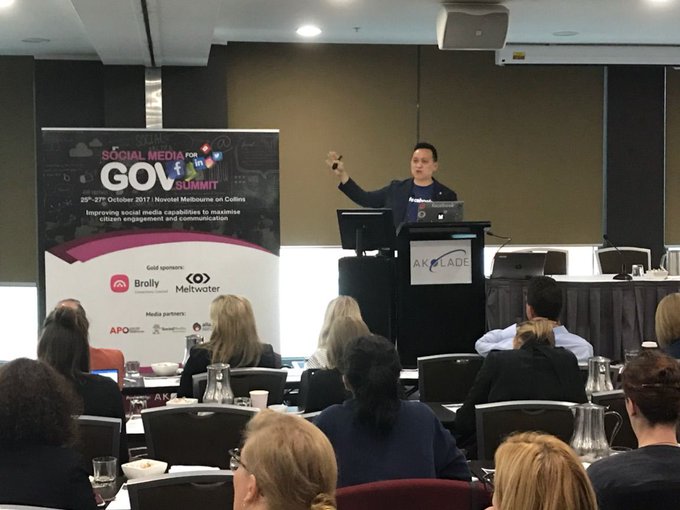
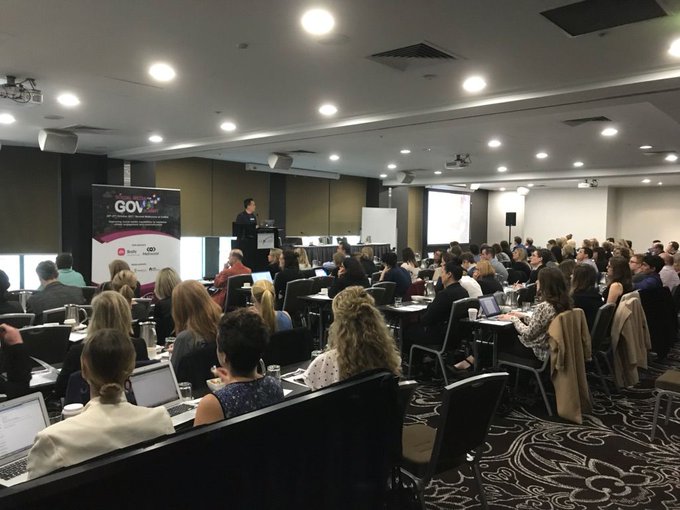
It was just one of the many challenges and insights at this 9th Social Media in government conference by Akolade Australia in Melbourne.
How to harness social media video and put communities at the centre of policy remain top priorities for communications in the public sector.

Key takeaways from the experts

Having Facebook and Instagram in the room was clearly a draw-card. You don’t often get updates from the social media giant about Australian numbers, but Facebook’s APAC Government and Policy lead Roy Tan was there to deliver them:
  • 12 Million Australians are checking Facebook every day.
  • More than 90 percent of those check on Mobile
  • They spend about 1 hour and 40 minutes a day on Facebook and check the platform about 14 times a day.


View image on TwitterView image on Twitter

It's a full house today @ . Pleased to have Roy from  introducing  ,  & how to's on reach for gov
The advice from Facebook for government was clear: be authentic and use lots of video to do it. This, not surprisingly, is a challenge for many agencies. Video is expensive and requires technical skill. Many of the attendees talked about a shift to inhouse video production and low-cost video production as a way to get value for money.

Decentralise and federalise

A recurring theme from speakers such as Mark Bayly from Victoria Police and Susan Manniche from the Bureau of Meteorology was the need to decentralise and trust content creators across an agency. For example, the Bureau’s social media team has several hundred people (meteorologists or comms) trained and authorised to Tweet.
How to leverage content across a government agency was also the message in my own presentation.  I appealed for agencies to have a policy and governance framework that frees up content creators or channel owners. Let communication teams know what they can and can’t do on a platform such as Facebook on behalf of the agency. Clear boundaries means better response times for customers.

What happens next?


Despite a decade of rapid growth in digital engagement, many government agencies are still grappling with the basics. This is a reflection of low risk appetite, and ultimately a desire to get the strategy right and ensure value for money. Another commonality was evident from questions from the conference floor time and time again: social media is worth the learning curve because social media can put the customer front and centre of communications.

Guest blog written by:
John Kerrison


John Kerrison was a broadcast journalist for 11 years who worked in Sydney, Adelaide and Canberra. He hosted Technology Behind Business for Sky News. He has a Masters in Organisational Communication from Charles Sturt University with a focus on new media and crisis communication. He currently works for the NSW Government in a strategic role, advising on social and digital media.